Spring 2026
Strength and conditioning strategies for mission-ready performance
Designing year-round periodization for tactical operators implies devising a training and exercise program planned out for the year ahead or a macrocycle to be mission-ready. This macrocycle, which gives the tactical athlete “macro, long-term, master plan or million-dollar view,” provides the framework and roadmap to see their physical capabilities and prowess develop in the upcoming several months to year ahead. This terminology is traditionally applied to athletes and their respective training seasons, but these same principles can be and will be explained for the benefit of the tactical athlete.
According to this periodization model, the seasons consist of the preparatory (prep) period or offseason, competition or in-season and the transition or postseason. The prep period is the most time-consuming part as the longest phase in which a base level of conditioning is developed and includes low intensity and high volume. The competition period is specific and involves focusing on strength and power peaking through low volume and high-intensity. Lastly, the transition period is known as an active rest following a sports season to afford the athlete cognitive, musculoskeletal and physical recovery.
With all this in mind, it is still necessary to keep avoiding overtraining with the proper implementation of deload weeks written into a tactical athlete’s program. Now that we have the overview of the year-round periodization, the macrocycle and its components, let’s further dive into how we design a meaningful exercise strength and conditioning program for our tactical athletes.
A tactical athlete’s job takes on several physical components which requires them to be well-rounded and ready for anything.
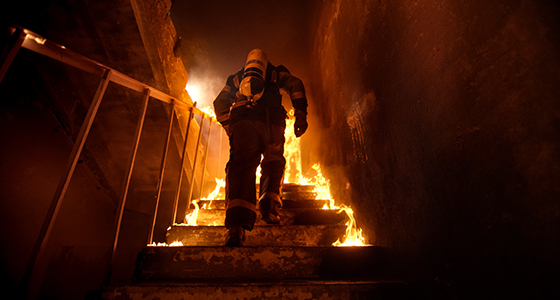
A tactical athlete or first responder can be any of the following: police, fire, corrections, military who carry additional weight or external loads during their shifts or missions and under stressful events and situations. None of their daily duties are routine and they never go to work doing exactly the same movement in the same order every day as the nature of their calls vary. A tactical athlete could be sitting idly in a patrol car, walking their respective city’s streets on foot patrol, in a physical altercation, removing hosing lines rapidly and quickly engaging in a fire, carry breaching tools to combat a fire, be dropped off at a certain location in theatre to only walk a longer distance for an objective or perform a jail cell extraction.
The underlying common denominator is that to be any of these tactical athletes or operators, it requires them to collectively demonstrate and exhibit feats of strength, power, muscular endurance and cardiovascular capacity/efficiency in job-specific skills. Examples of these feats are found in the daily duties stated above but are still met in so many more unexpected circumstances which happen at a moment’s notice.
Why does this matter?
As evidenced above, a tactical athlete’s job takes on several physical components which requires them to be well-rounded and ready for anything. They cannot be one-dimensional and only train for one physical exercise, because that one exercise might only work one of their three energy systems which are phosphagen, slow/fast glycolytic and oxidative.
A tactical athlete can surely be a bodybuilder and win all the shows they enter, which is fantastic, but if they cannot run after a suspect for more than 400 yards or pull hoses off a truck efficiently, they not only might not be best-suited for their current job’s objective but also might create issues for their respective team. This same holds true for an endurance athlete, such as a marathon runner. We hope they win all their races, but this training focuses on aerobic training and minimal power training. A tactical athlete here might be physically challenged while fighting a suspect during a roadside encounter or domestic dispute because all their training is aerobic and these instances are anaerobic, utilizing feats of power and utilizing the phosphagen energy system.
Devising a program
With this mind and how the a tactical can certainly be a master of a certain exercise regimen, realistically, they need to be a jack of all trades, ready for anything and extremely competent in displaying feats of strength, power, lean muscle tissue, muscular endurance, anaerobic and aerobic conditioning for mission-ready specificity. Therefore, building a macrocycle or yearly program can be broken down into four months of three separate strength and conditioning programs.
An easy routine to start with would be a simple four days of weight/resistance training and three to four days of anaerobic and aerobic conditioning. These months may look like the following:
- Months 1-4: Hypertrophy/muscle-building focus with six to 12 repetitions with generally a 45-90 second rest between sets, bodyweight exercises and slow steady-state cardio and sprint work two times per week.
- Months 5-8: Power/strength focus with two to six repetitions with generally a two-to-five minute rest period between sets, slow steady-state cardio, threshold/tempo runs and sprint work three to four times per week.
- Months 9-12: Muscular-endurance focus with repetitions at or above 12 with generally a 30-60 second rest period between sets, bodyweight exercises, slow steady-state cardio, threshold/tempo runs and sprint work three to four times per week.
Within these blocks of training, it is critical for a tactical athlete to take a deload week typically every five to eight weeks during their training regimen. Within the deload week, volume is reduced typically to 50 percent, give or take a few percentage points, and intensity stays the same. An illustration of this would be if you perform four sets of 12 repetitions with 100 pounds on a bench press, then, on your deload week, you would perform two sets (volume) and 12 repetitions with 100 pounds (intensity) which stays the same. Obviously, this same pattern stays the same for all the exercises in your daily routine. With this, you will help your body recover from the previous weeks of training and properly prepare for the subsequent weeks of training.
If you want to achieve optimal human performance for yourself and prevent musculoskeletal injury, program these into your routine ASAP. Going 100 percent week after week and year and after year will leave you not only physically, mentally and cognitively exhausted and burn you out, but might affect you more than you think in a critically important and life changing situation. Train hard, train safe and train smart.
Contact Borowick via the DOMEX Strength & Fitness website, via Instagram, LinkedIn or at Domexstrengthandfitness@gmail.com for a professional consultation on a tailor-made exercise program or on becoming optimally and tactically fit.