Winter 2026
Ekso Bionics is changing the lives of disabled veterans through exoskeleton technology
Ekso Bionics is playing a pivotal role in helping disabled veterans regain independence. More than just walking again, they aim to provide veterans who sustained lower extremity, spinal, or traumatic brain injuries the ability to recapture a spark for life that may have been dulled by an inability to do little things — from getting in and out of a vehicle to performing cardiovascular work to simply being able to hug loved ones.
Backed by more than 10 years of rehabilitation research and supported by recent policy changes that expand access, Ekso’s Indego Personal exoskeleton is becoming more prominent in VA medical centers and veterans’ homes to restore standing, walking, fitness, and everyday function. Ekso Bionics began with military load-carriage research, and the company soon realized its biggest impact would be in medical mobility.
For veterans, the technology begins with a simple question.
“The first thing I ask every vet is, ‘Why do you want to do this?’” said Adam Kesten, Ekso’s Clinical Training Manager-North America. “Sometimes it’s to cook dinner while standing. Sometimes it’s to walk around the neighborhood. Sometimes it’s just to stand face-to-face with family again. The goals are always very personal.”
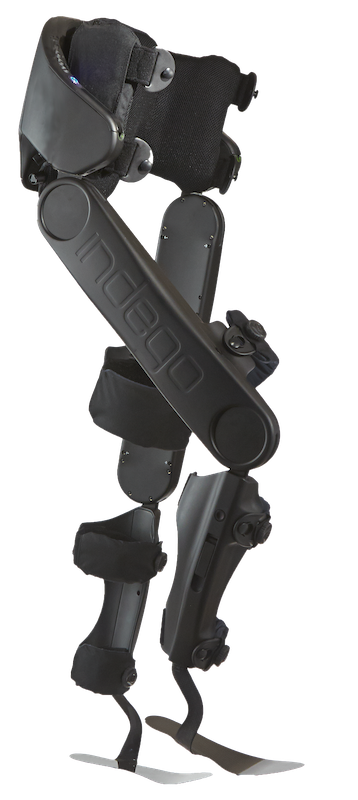
The Indego Personal was designed to meet these goals. The device is built with five lightweight components — an upper-torso piece, two thigh sections, and two lower-leg sections — allowing for easy transportation and practical home use.
“It’s incredibly user-friendly,” Kesten explained. “You don’t feel like you’re carrying a big backpack. The weight is engineered so you don’t notice it.”
Operating the Indego Personal is rather intuitive. Users start by simply leaning forward.
“If you lean forward with purpose, it walks. If you stop leaning, it stops,” he said. “Clinicians can adjust how much power the device gives and how much the user has to give. If the person has some available muscle strength, we can let them use it.”
“We see improvements in cardiovascular health, bowel and bladder function, weight management, bone density — the list goes on,” Kesten said. “But the biggest impacts are often emotional. One veteran told us, ‘I was able to stand and hug both of my daughters at the same time for the first time in years.’ That’s not just mobility. That’s life-changing.”
For Rachael Anderson, Ekso’s VP of North American Sales, those types of emotional anecdotes are a major driver in continuing the work.
“Our philosophy is to listen first, to veterans, to clinicians, to families,” she said. “We don’t build technology in a vacuum. We build it because people tell us what they need. And the feedback shapes everything we do, from engineering to customer support.”
The availability of Ekso’s devices has improved, thanks in part to major policy developments. The Department of Veterans Affairs recently approved qualifying veterans to use the Indego Personal exoskeleton for everyday activities outside of clinics at zero cost. Additionally, Medicare allows for a reimbursement option under its brace benefits policy. And for those not in the military, workers’ compensation is available for law enforcement officers and firefighters who are injured in the line of duty.
“Access is the game-changer,” Anderson said. “For years, exoskeletons were confined to big rehab centers. Now, veterans [and tactical operators injured in the line of duty] can bring that mobility into their own homes and communities.”
With the increased access comes structured training, a mandatory requirement for both the user and his/her support person. Veterans in the VA complete an average of 20-30 supervised training sessions, followed by an at-home trial lasting multiple weeks.
“We take safety extremely seriously,” Kesten said. “We want to make sure the veteran and the support person know exactly how to operate the device in every situation — transferring from a wheelchair, getting in and out of a car, navigating the home.”
Ekso maintains long-term involvement after the device is issued.
The Ekso Bionics Indego orthotically fits to the lower limbs and trunk and is intended to:
• Enable individuals with spinal cord injury at levels T3 to L5 to perform ambulatory functions with supervision from a trained support person according to the user assessment and training certification program,
• Enable individuals with spinal cord injury at levels C7 to L5 to perform ambulatory functions in rehabilitation institutions according to the user assessment and training certification program, and
• Enable individuals with hemiplegia (with motor function of 4/5 in at least one upper extremity) due to cerebrovascular accident to perform ambulatory functions in rehabilitation institutions according to the user assessment and training certification
program.
The Indego is not intended for sports or stair climbing.
“We don’t just hand someone an exoskeleton and disappear,” Anderson said. “Our clinical team stays engaged with therapists. Our customer support team checks in regularly. The goal is for the device to be used, not to sit in a closet.”
That level of communication and commitment helps veterans transform training into a daily routine. Kesten recalled one user whose goal was simply to stand at the sink and wash dishes without water running down his arms and soaking his clothes.
» ALSO SEE: How AI will personalize training through real-time readiness data
“That was independence for him,” he said. “Another veteran told us, ‘I stood up for my anniversary dinner. I haven’t done that since my injury.’ These are the moments that matter.”
Both Anderson and Kesten stress that exoskeletons are not “sci-fi suits,” like what’s portrayed in Hollywood movies. Instead, they are mobility tools that require training, discipline, and an understanding of realistic expectations. The benefits, when trusting the process, are undeniable.
“When veterans realize what they can do again, you see confidence come back,” Anderson said. “You see energy come back. You see purpose come back. We encourage veterans, clinicians, and families to just start the conversation. Ask questions. Learn about eligibility. See what’s possible.”